




New Products


N-Type Connectors
Introduction
GigaLane N-type connectors are designed for applications up to 11 GHz Because of the endurance, it is optimum for high power fixed wireless communication equipments.
기가레인의 N 형 커넥터는 최대 11 GHz의 응용 프로그램 용으로 설계되었습니다. 내구성 때문에 고전력 고정 무선 통신 장비에 적합합니다.
기가레인의 N 형 커넥터는 최대 11 GHz의 응용 프로그램 용으로 설계되었습니다. 내구성 때문에 고전력 고정 무선 통신 장비에 적합합니다.
Interface Standards (MIL-STD-348)
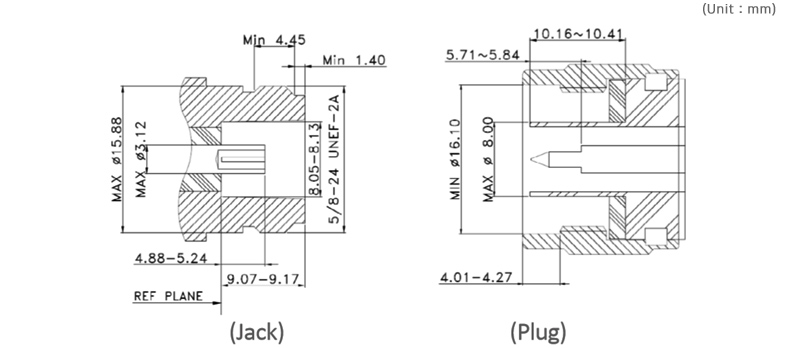
Specification
| Frequency | DC ~ 11 GHz |
| Impedance | 50 Ω |
| VSWR | 1.2 : 1 to 11 GHz |
| Insulation Resistance | 5000 MΩ |
| Dielectric Withstand Voltage | 1200 Vrms max |
| Contact Resistance - Outer Conductor - Inner Conductor |
1 mΩ max 1 mΩ max |
| Insertion Loss | 0.2 dB max @ 11 GHz |
| RF Leakage | -60 dB |
| Power Handling | 500W (@ 2 GHz) |
Mechanical
| Mating Cycle(Durability) | 500 |
| Recommended Mating Torque Proof Torque |
Proof Torque 0.68 ~ 1.33 Nm / 5 ~ 12 lbs 1.7 Nm / 15.0 lbs |
| Coupling Nut Retention Force | 450 N / 45.8 kfg / 61 lbs |
| Contact Captivation | 2.8 kgf Min. (28N Min.) |
Environmental
| Temperature | -40˚C to + 125˚C |
| Thermal Shock | MIL-STD-202, method 107, test condition B |
| Corrosion (Salt Spray) | MIL-STD-202, method 101, test condition B, 5% salt |
| Shock | MIL-STD-202, method 213, condition B (20G) |
| Vibration | MIL-STD-202, method 204, condition I (100G) |
| Moisture Resistance | MIL-STD-202, method 106 |
Material
| Body | Brass | Ni Plated |
| Center Contact | Beryllium Copper(BeCu) Brass |
Gold Plated Gold Plated |
| Insulator | PTFE | ㅡ |
| Gaskets | Silicon | ㅡ |
Tel : +82-70-7872-0701Fax : +82-2-2167-3801
2F, ACE hightech city, 775, Gyeongin-ro, Yeongdeungpo-gu, Seoul, Korea
2F, ACE hightech city, 775, Gyeongin-ro, Yeongdeungpo-gu, Seoul, Korea